Install a 4-Way Flat Connector: Step-by-Step With Diagram
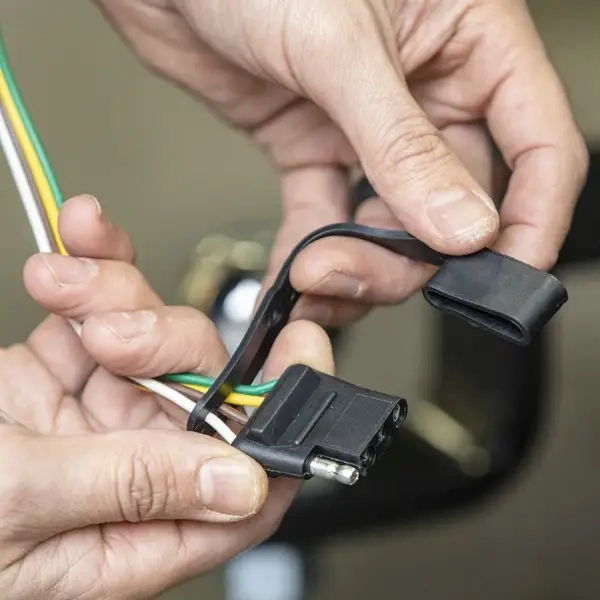
A 4 way flat trailer plug connects ground, taillights, left turn/brake and right turn/brake between your tow vehicle and trailer. The flat rectangular design is standard on utility trailers, boat trailers and most trailers under 80 inches wide.
Installation takes 30-60 minutes with basic tools. The hardest part is accessing your vehicle’s tail light wires—the actual connections are straightforward once you identify the right wires.
4 Way Flat Wiring Diagram
Standard Wire Colors
| Wire Color | Function | Pin Position |
|---|---|---|
| White | Ground | Center bottom |
| Brown | Tail/marker lights | Top center |
| Yellow | Left turn + brake | Top left |
| Green | Right turn + brake | Top right |
This color code is standardized across manufacturers. If your trailer has different colors, the connector pin positions stay the same—just match functions, not colors.
Visual Pin Layout
Looking at the female (trailer side) connector:
 ┌───────────────────┐
 │ ○ ○ ○ │
 │ YEL BRN GRN │
 │ ○ │
 │ WHT │
 └───────────────────┘
The offset ground pin ensures correct orientation and connects first when plugging in.
Buying the Right 4 Way Flat
Vehicle Side (Male)
The tow vehicle gets the male connector—the one with exposed pins. This mounts under the rear bumper or on a trailer hitch.
Options:
- Hardwired harness: Splice into vehicle wiring
- Plug-and-play harness: Vehicle-specific, plugs into existing connectors
- Powered converter: For vehicles with combined brake/turn signals
Trailer Side (Female)
The trailer gets the female connector—the one with pin sockets. This mounts on the trailer tongue.
Types:
- Bonded wire: Four wires molded together, clean look
- Wishbone harness: Splits to left/right with ground, most common
- Replacement connector: Just the plug for rewiring existing harness
Installation: Vehicle Side
Method 1: Direct Splice (Most Vehicles)
Works on trucks and SUVs with separate turn signal and brake light circuits.
Step 1: Access tail light wiring
Usually behind the rear bumper, in the trunk/hatch area, or at a body connector near the tail lights.
Step 2: Identify wires with test light
With a helper operating vehicle controls:
- Parking lights on → find wire that lights up (tail circuit)
- Left turn signal → find flashing wire (left turn)
- Right turn signal → find flashing wire (right turn)
- Ground → test light to battery positive, probe various wires
Step 3: Tap into circuits
For each circuit:
- Cut vehicle wire
- Strip both ends plus trailer harness wire
- Join all three with butt splice connector or solder
- Protect with heat shrink or electrical tape
Step 4: Ground connection
Critical step. Options:
- Existing ground stud under vehicle
- Self-tapping screw into clean frame metal
- Bolt through frame with ring terminal
Method 2: Plug-and-Play Harness
Many vehicles have harness-specific kits that plug into existing connectors at the tail lights. No cutting or splicing required.
Check for: CURT, Hopkins, Tekonsha, Draw-Tite kits for your specific vehicle.
Advantages:
- Faster installation
- No permanent modification
- Preserves factory warranty
Method 3: Powered Converter
Required when your vehicle uses the same filament for brake and turn signals (common on older American cars, some imports).
The converter:
- Separates combined signal into distinct brake/turn outputs
- Provides proper load for trailer lights
- Often includes 12V power tap
Installation: Trailer Side
Connector Mounting
Mount the female connector on the trailer tongue where:
- It reaches tow vehicle connector easily
- It won’t drag on ground
- It won’t get submerged (boat trailers: mount higher)
Mounting options:
- Weld-on bracket
- Bolt-on bracket
- Clamp mount for round tongues
Running Wires
Main run: From connector down center of tongue
Split point: Where trailer frame splits left and right
Branch runs: To each light, protected in loom or conduit
Tips:
- Leave service loops at connection points
- Secure every 18” with zip ties or clamps
- Keep wires away from tires, springs, moving parts
Connecting Lights
Most trailer lights have:
- White wire: Ground (connect to frame AND run back to main harness)
- Colored wire: Signal (connect to matching harness wire)
Don’t rely on mounting screws for ground. Run a dedicated ground wire from each light to the trailer frame.
Troubleshooting Problems
No Lights At All
Check sequence:
- Vehicle fuse (labeled “trailer” or “tow”)
- Connector pin corrosion—clean with contact cleaner
- Vehicle-side ground connection
- Trailer-side ground connection
One Side Works, Other Doesn’t
Trailer side problem if:
- Test light shows power at connector but lights don’t work
- Other vehicles work fine with this trailer
Vehicle side problem if:
- Test light shows no power at connector on that circuit
- Same trailer works on another vehicle
Dim Lights
Almost always a ground problem. Check:
- Main ground at connector
- Ground at each individual light
- Corrosion at any ground point
Fix: Run new ground wire from lights to clean frame contact.
Lights Flicker While Driving
Causes:
- Loose connector—tighten or replace
- Broken wire in harness—flex wires to find break
- Bad pin contact—spread female pins slightly for tighter grip
Turn Signals Flash Wrong Speed
Fast flash: Low load detected (burned bulb, bad connection)
Slow flash: High resistance (corrosion, poor ground)
Comparison With Other Connectors
| Feature | 4 Way Flat | 5 Pin | 7 Pin |
|---|---|---|---|
| Tail lights | ✓ | ✓ | ✓ |
| Turn/brake | ✓ | ✓ | ✓ |
| Electric brakes | ✗ | ✓ | ✓ |
| 12V power | ✗ | ✗ | ✓ |
| Reverse lights | ✗ | ✗ | ✓ |
| Common use | Light duty | Braked trailers | Heavy duty |
Upgrade to 5 pin if you add electric brakes. Upgrade to 7 pin for full features.
Adapter Options
7 Way to 4 Way Adapter
Use your 4-pin trailer with a vehicle that has 7-pin connector. Only basic lights function—electric brakes and 12V power don’t transfer.
Cost: $10-20
4 Way to 7 Way Adapter
Use a 4-pin trailer plug with a 7-pin vehicle receptacle. Same limitations—only the four basic circuits connect.
Cost: $10-20
Extension Cables
Add length between vehicle and trailer connector. Useful for long-tongue trailers or unusual mounting positions.
Available lengths: 2 ft, 4 ft, 6 ft common
Maintenance Tips
Before Each Trip
- Plug in connector
- Turn on running lights—all should illuminate
- Test left turn—left lights flash
- Test right turn—right lights flash
- Test brakes—both sides light
Monthly (Active Use)
- Apply dielectric grease to connector pins
- Check for wire chafing at frame contact points
- Verify ground connections are tight
Seasonal (Storage)
- Disconnect and clean connector
- Check for rodent damage to wiring
- Test all functions before first use
Related Guides
- 4 Pin Trailer Wiring Diagram — Detailed wiring diagrams
- 5 Pin Trailer Connector — Electric brake upgrade
- 7 Pin Trailer Connector — Heavy duty wiring
- Trailer Wiring Diagram Guide — All connectors compared
- Automotive Circuit Tester — Testing trailer wiring