Briggs & Stratton 591736 Carburetor | Repair Guide
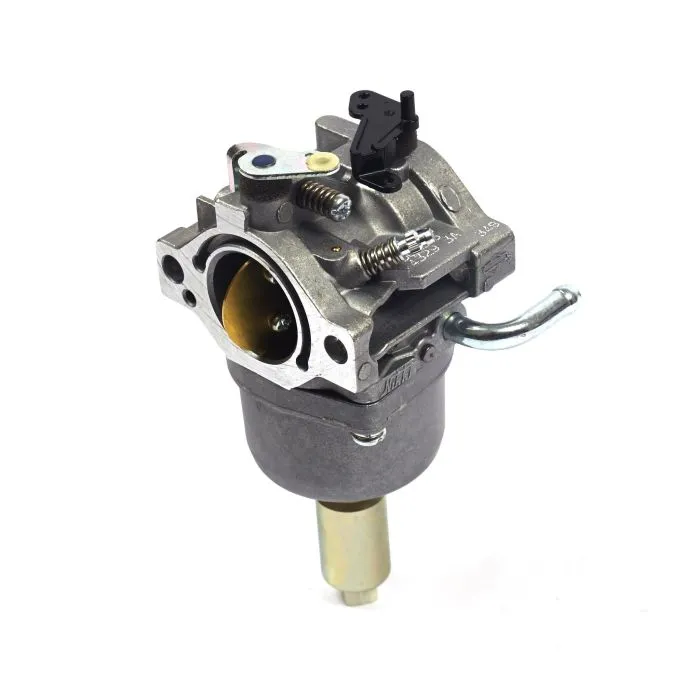
The Briggs & Stratton 591736 (supersedes 796587) carburetor serves 19 to 19.5 horsepower Intek V-Twin engines. These power popular riding mowers from Craftsman, Husqvarna, John Deere and Troy-Bilt. When your riding mower won’t start or runs rough, this carburetor is often the problem.
Table of Contents
- Engines and Equipment Using the 591736
- Part Number Cross-Reference
- Symptoms of Carburetor Failure
- Replacement Procedure
- Rebuild and Cleaning
- Solenoid Testing
- Tuning and Adjustment
Engines and Equipment Using the 591736
This carburetor fits Briggs & Stratton Intek series V-Twin engines rated 19-19.5 HP.
Riding Mowers:
- Craftsman LT2000, YT3000 series
- Husqvarna YTH22V46, YTH2348
- Troy-Bilt Bronco, Pony series
- MTD Gold and Platinum tractors
- Yard-Man riding tractors
- Poulan Pro riding mowers
Engine Model Numbers:
- 33R877
- 331877
- 33S877
- 33R677
Displacement: 540cc (Twin cylinder)
[NEED REAL IMAGE: Engine model/type number location on Intek V-Twin]
The engine model is stamped on a decal or metal plate on the engine shroud, typically near the oil fill.
Part Number Cross-Reference
Several numbers interchange:
| Part Number | Notes |
|---|---|
| 591736 | Current production |
| 796587 | Previous number, same carb |
| 594601 | With different solenoid |
| 591731 | Similar, verify before ordering |
This carburetor features:
- Nikki-style design
- Anti-afterfire solenoid
- Adjustable high-speed mixture screw
- Fixed low-speed circuit
- Primer system
Symptoms of Carburetor Failure
Engine Cranks But Won’t Start
Most common complaint. The engine turns over but never fires or only pops.
Check:
- Fuel reaching carburetor bowl
- Anti-afterfire solenoid operation
- Spark at both plugs
Backfiring Through Carburetor
Flames or loud pops from the air filter area during starting or running.
Causes:
- Intake valve issue (not carb related)
- Extremely lean mixture
- Timing problem (less common)
Backfiring Through Exhaust When Shutting Off
The anti-afterfire solenoid has failed. This solenoid cuts fuel when the key is turned off. Without it, unburned fuel ignites in the hot muffler.
Surging Under Load
Engine speed fluctuates while mowing. RPMs bounce up and down.
Causes:
- Partially clogged main jet
- Fuel delivery restriction
- Governor linkage binding
Black Smoke and Fouled Plugs
Engine runs rich. Both spark plugs turn black and sooty.
Causes:
- Stuck float or needle
- Choke not opening fully
- High-speed mixture screw too far out
Fuel Leaking From Carburetor
Gas drips from carb body or overflow.
Causes:
- Float needle not seating
- Cracked float
- Bowl gasket failure
Replacement Procedure
Time required: 45-60 minutes
Tools Needed
- 3/8” and 1/2” socket set
- Flathead and Phillips screwdrivers
- Needle-nose pliers
- 5/16” and 3/8” wrenches
- Fuel line clamp or vice grips
- Shop towels
- Drain pan
Step-by-Step
1. Disconnect Battery
Remove the negative cable first. This prevents sparks and accidental starting.
2. Access the Carburetor
Remove the engine shroud if necessary. On most tractors, the carb is accessible from the side without full shroud removal.
[NEED REAL IMAGE: Accessing carburetor on riding mower Intek engine]
3. Photograph Everything
Take multiple photos of all linkage and hose connections before touching anything.
4. Shut Off Fuel
Close the fuel shutoff valve under the tank. If there’s no valve, clamp the fuel line.
5. Disconnect Fuel Line
Have your drain pan ready. Pull the fuel line from the carburetor inlet.
6. Disconnect Solenoid Wire
One wire connects to the anti-afterfire solenoid on the carb bowl. Pull the connector off.
7. Remove Air Filter Housing
Usually 2-4 bolts. Set aside the complete assembly.
8. Disconnect Throttle and Choke Linkages
Multiple rods and springs connect to the carburetor. Photograph each one before removal. Use needle-nose pliers to unhook springs.
9. Remove Mounting Bolts
Two studs with nuts typically hold the carb to the intake manifold. Support the carb while removing the second nut.
10. Remove Carburetor
Pull straight off the studs. Watch for the gasket - note which side faces the engine.
11. Install New Carburetor
Use a new gasket. Slide carb onto studs, hand-start nuts.
12. Reconnect All Linkages Per Photos
Take your time here. Wrong linkage positions cause no-start or runaway conditions.
13. Reconnect Fuel Line and Solenoid Wire
14. Reinstall Air Filter Assembly
15. Open Fuel Valve, Check for Leaks
Let fuel fill the bowl. Watch for drips.
16. Reconnect Battery and Test
Engine should start within a few cranks.
Rebuild and Cleaning
Rebuilding saves money if the carb isn’t corroded internally.
Rebuild Kit Contents
- Bowl gasket
- Inlet needle and seat
- Float (sometimes)
- Mixture screw o-ring
- Various small gaskets
Cost: $15-25 vs $65-90 for new carb
Disassembly
1. Remove the bowl
Four screws around the perimeter. Catch remaining fuel.
2. Remove float assembly
Push out the hinge pin. Lift float and needle together.
3. Remove main jet
Center of the carb body, usually requires a flathead screwdriver. Note: main jet size is calibrated - don’t swap with a different size.
4. Remove mixture screw
Count turns as you remove it. Write this down for reinstallation. Usually 1.5-2 turns out from lightly seated.
Cleaning
1. Soak metal parts in carb cleaner
Berryman Chem-Dip or equivalent. One hour minimum.
2. Blow out all passages
Compressed air through every orifice. The idle circuit passages are tiny - make sure air flows through.
3. Inspect needle and seat
Viton-tipped needles last longer. Replace if the tip is grooved or hardened.
4. Check float
Shake it. If you hear liquid inside, it’s punctured. Replace.
Reassembly
Use all new gaskets from the kit. Set mixture screw to your recorded position or factory spec (typically 1.5 turns out).
Solenoid Testing
The anti-afterfire solenoid is a common failure point.
How It Works
When the key is ON, 12V energizes the solenoid, retracting the plunger and allowing fuel to flow. When you turn the key OFF, the solenoid extends and blocks the fuel passage, preventing backfire.
Testing Procedure
1. Remove solenoid from carb
Unscrew it from the bowl area.
2. Connect to 12V source
Use a battery or power supply. Connect positive to solenoid terminal, negative to solenoid body.
3. Watch plunger movement
The plunger should retract with power and extend with power removed. Movement should be smooth.
4. Listen for click
A working solenoid clicks when power is applied and removed.
[NEED REAL IMAGE: Testing anti-afterfire solenoid with multimeter/battery]
No movement = bad solenoid. Replace it ($20-35).
Solenoid Replacement
Unscrew the old one, apply thread sealant to the new one, install and tighten. Don’t overtorque - the carb body is aluminum.
Tuning and Adjustment
High-Speed Mixture Screw
Located on the side of the carburetor body (not the bowl).
Base setting: 1.5 turns out from lightly seated
Fine tuning:
- Start engine and warm up 5 minutes
- Engage mower deck at full throttle
- Turn screw in (clockwise) until engine stumbles
- Turn screw out (counterclockwise) until engine stumbles
- Set halfway between the two stumble points
Governor Adjustment
If engine speed is wrong after carb replacement:
- Loosen governor arm clamp bolt
- Rotate governor shaft clockwise (looking from above)
- Move throttle to wide open
- Tighten clamp bolt
- Check RPM: should be 3300-3600 at no load
Choke Adjustment
The choke should close fully when cold and open fully when warm. Check linkage for binding or damage if choke doesn’t operate correctly.
Aftermarket Options
Genuine Briggs 591736: $75-95 Aftermarket: $25-45
Aftermarket carbs for V-Twins have more quality variation than smaller carbs. Issues include:
- Solenoid threads not matching
- Float height calibration off
- Casting flash in passages
For a tractor worth keeping, genuine is safer. For a budget repair, aftermarket can work but inspect carefully before installation.
Frequently Asked Questions
Why does my mower backfire when I shut it off?
Failed anti-afterfire solenoid. Test and replace if it doesn’t click and retract.
Can I run without the solenoid?
Temporarily, yes. Plug the hole. But you’ll get backfiring on shutdown. Replace the solenoid when possible.
My new carb runs rich. What now?
Turn the high-speed mixture screw clockwise (in) 1/4 turn at a time until it runs cleaner. Also verify choke is fully opening.
The engine hunts at idle but runs fine under load.
Clean or replace the idle circuit components. The low-speed passages may be partially blocked.
V-Twin carburetors are more complex than single-cylinder units. Take photos, label everything and work methodically. The extra time prevents frustrating reassembly mistakes.